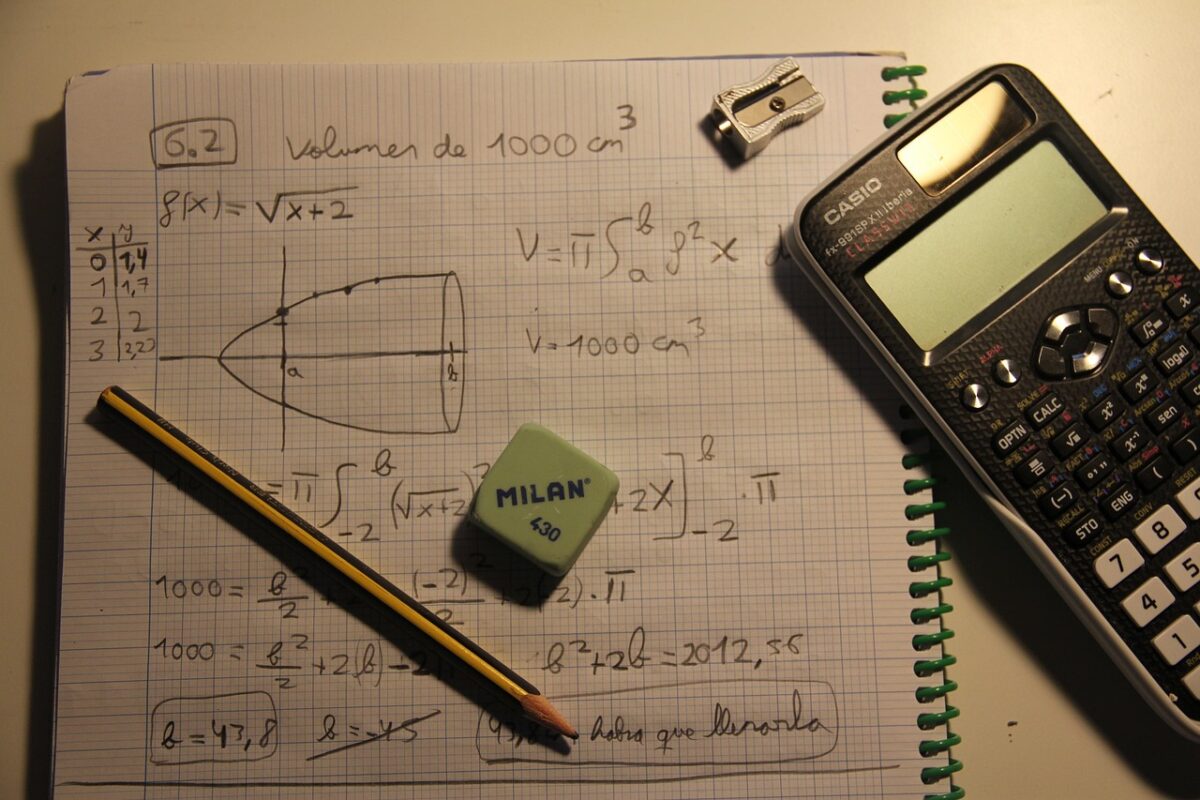
A calculator does exactly what it is told. Most wrong answers are correct arithmetic on an expression that was not the one intended. These five account for the large majority.
1. Minus versus negative
Almost every scientific calculator has two different keys: subtraction, and unary negation (often marked (−) or +/−). They are not interchangeable.
Entering −3² with the subtraction key on a two-line machine can produce a syntax error, or worse, an answer. Entering it with the negation key gives −9, because the square is applied before the negation. If you want (−3)², you must type the brackets.
This is the single most common source of sign errors, and because the answer looks plausible it usually goes unnoticed.
2. The fraction bar has invisible brackets
Written on paper, a fraction bar groups everything above it and everything below it. On a one-line calculator, it does not.
The expression with numerator 3 + 5 and denominator 2 is 4. Typed as 3 + 5 ÷ 2 it gives 5.5, because the division binds only to the 5. It has to be entered as (3 + 5) ÷ 2.
Four-line “MultiView” style displays help here, because you enter the fraction in the shape it is written and the grouping is handled for you. This is the strongest practical argument for a textbook-display model.
3. Degrees, radians and gradians
A small indicator in the corner of the display — DEG, RAD or GRAD — decides what sin, cos and tan mean.
sin(30) is 0.5 in degree mode and −0.988 in radian mode. Both are correct; only one is what you meant. Trigonometry answers that are wildly wrong for no apparent reason are nearly always this.
Check the indicator before starting any trigonometry, and check it again if someone else has used the machine. Calculus work is usually in radians; geometry usually in degrees.
4. Implied multiplication
On paper, 2(3 + 4) obviously means 2 × 7. Calculators vary in how they treat an implied multiplication next to a bracket or a variable, particularly when it appears in a denominator.
The expression 1 ÷ 2π is read by some machines as (1 ÷ 2) × π and by others as 1 ÷ (2 × π). These differ by a factor of about ten. The fix is not to learn which your machine does — it is to type the brackets every time. It costs two keystrokes.
5. Rounding too early
Working through a multi-step problem and writing down a rounded intermediate value, then typing that rounded value back in, introduces error that compounds. In a three-step calculation with values rounded to two decimals at each step, the final answer can be wrong in the first decimal place.
Use the ANS key, or the machine’s memory, to carry the full-precision value forward. Round once, at the end, to the precision the question asks for.
A habit worth building: estimate first
Before pressing equals, have a rough idea of the answer. 47 × 19 is about 50 × 20, so about 1000. If the display says 8930, something went in wrong.
This single habit catches nearly all of the errors above, because every one of them produces an answer that is wrong by a noticeable factor rather than a small amount.
Clearing properly
Know the difference between clearing the entry and clearing everything. On most machines one key clears the current entry and another resets the calculation. Memory and statistics registers usually need clearing separately — a leftover data set from the previous question produces confidently wrong statistics.
Our calculator range lists the display type for each model, which is what determines how much of this the machine handles for you.